Building a charcoal production plant starts with deciding what you will sell and what you can source reliably. “Charcoal” may mean BBQ charcoal, shisha/hookah charcoal (often from coconut shell), industrial reductant, or biochar for agriculture—each has different requirements for fixed carbon, ash, volatile matter, size, and hardness. Next, lock in the feedstock: wood chips, sawdust briquettes, coconut shells, bamboo, or other biomass. Consistency matters more than many new operators expect; a continuous carbonization machine performs best when moisture, particle size, and contamination (soil, stones, metal) are controlled. In most cases, plan for feedstock moisture below about 15% to improve throughput and stabilize reactor temperature.
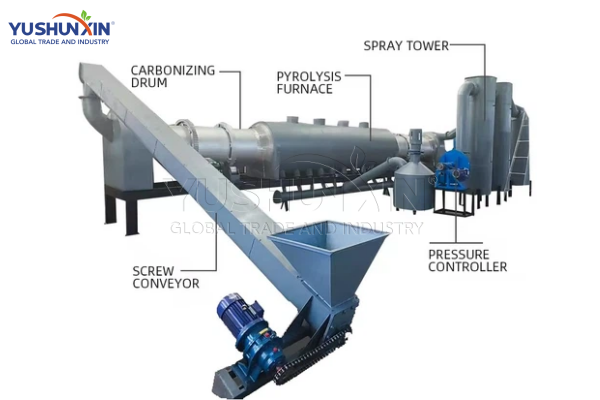
Select the Continuous Carbonization Machine and Target Capacity
Choose a continuous carbonization machine based on your capacity goal (tons/day), feedstock form (chips vs. powder vs. shells), and desired automation level. Common designs include rotary drum carbonizers and screw-type reactors. Key parameters to confirm with suppliers are residence time, heating method (indirect heating is common), temperature range, sealing performance (oxygen control), and the type of char cooling system. Your target capacity should consider not only the reactor rating, but also upstream drying limits and downstream packaging speed. A practical approach is to size for peak feed availability and then run at a steady, lower setpoint to protect equipment and maintain quality.
Plan the Plant Layout: Flow, Safety, and Maintenance
A typical plant layout follows a straight-through material flow: raw material receiving → screening/crushing → drying (if needed) → metered feeding → continuous carbonization → sealed cooling → screening → storage → bagging or briquetting. Keep “hot zones” (reactor, burner, hot gas ducting) separated from storage and packaging to reduce fire risk and dust ignition hazards. Provide generous access around the reactor, fans, and dust collectors for maintenance. Include magnets or metal detectors before the feeder to protect screws and drums from damage.
Integrate Energy Recovery and Emissions Control
One major advantage of continuous carbonization is that the generated pyrolysis gas can be burned to supply heat for the reactor (and sometimes the dryer), reducing fuel costs. Design a gas handling line with dust removal and tar management so the burner runs steadily. For compliance and community acceptance, incorporate appropriate emissions control—afterburner, cyclone, scrubber, bag filter, or a combination—based on local regulations and feedstock characteristics. Good sealing and controlled draft are essential to prevent smoke leaks and oxygen ingress. The design of continuous carbonization machine is more suitable large scale charcoal making.
Utilities, Commissioning, and Quality Control
Electrical power is mainly consumed by conveyors, reactor drive, induced draft fans, cooling equipment, and packaging—so allocate capacity with startup peaks in mind. Provide cooling water or a closed-loop cooler for the char cooling unit. During commissioning, tune feed rate, temperature profile, and cooling to prevent char re-ignition and to hit your target specifications. Finally, set up routine lab checks (moisture, ash, fixed carbon, volatile matter, size distribution) and a simple operating log. With consistent feedstock, a well-planned layout, and disciplined process control, a continuous carbonization plant can deliver stable production and predictable charcoal quality at industrial scale. Visiting: https://www.char-molder.com/product/continuous-carbonization-furnace/
Leave a Reply