Introduction
A hookah charcoal production line is a complete industrial system designed to convert biomass materials such as coconut shells, bamboo, sawdust, or wood waste into high-quality hookah charcoal tablets or cubes. With growing global demand for clean-burning and long-lasting shisha charcoal, modern production lines focus on efficiency, consistency, and emission control.
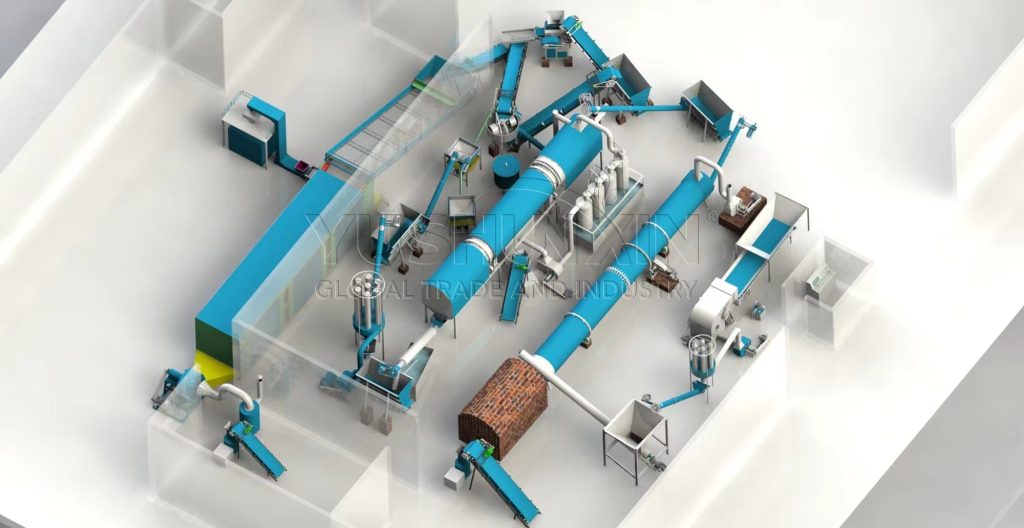
Production Process Overview
The hookah charcoal production process generally includes four main stages:
1. Raw Material Preparation
Raw biomass materials are first selected, dried, and crushed into uniform particles. Proper moisture control is important to ensure stable carbonization and high charcoal density.
2. Carbonization Process
Prepared materials are fed into a carbonization furnace or continuous carbonization machine. Under oxygen-limited conditions, the biomass is thermally decomposed into carbon-rich charcoal. This step directly determines ash content, fixed carbon level, and burning time of final products.
3. Grinding and Mixing
The carbonized material is then pulverized into fine powder using a charcoal grinder. Binders such as starch are added to improve molding strength and combustion stability.
4. Briquetting and Drying
The mixed powder is pressed into uniform shapes using a hydraulic or mechanical briquette press. The formed charcoal tablets are then dried to remove moisture and improve hardness.
Key Equipment in the Production Line
A complete hookah charcoal production line typically includes:
- Crusher and grinder system
- Carbonization furnace (batch or continuous type)
- Mixing machine with binder dosing system
- Charcoal briquette press machine
- Drying oven or mesh belt dryer
- Packaging system
Each machine plays a critical role in ensuring product density, burning time, and ash control performance.
Factory Layout Design
A well-planned factory layout improves efficiency and reduces production cost. The layout is usually arranged in a linear flow:
Raw material zone → Crushing zone → Carbonization zone → Grinding & mixing zone → Briquetting zone → Drying & packaging zone
For large-scale plants, separation between high-temperature carbonization areas and finished product packaging areas is recommended to improve safety and airflow management.
Conclusion
A modern hookah charcoal production line is not just a set of machines, but a fully integrated system. With optimized process design and proper equipment selection, manufacturers can achieve stable output, high calorific value charcoal, and competitive production costs in global markets. Visiting: https://www.ysxcharpro.com/product/hookah-charcoal-production-line/
Leave a Reply